
Taxing the Past. Funding a Different Future


Yesterday in London, the UK Chancellor stood at the despatch box and delivered what has been variously billed as a responsible budget. The numbers moved around predictably. A few incentives here, much sighing and restraint there. And whilst the media and much of the population are aghast at Rachel Reeves and the labour Government, this budget is little different to the Conservative budgets that preceded it — or those across Europe in recent years. The numbers when used as headlines sound large, £8BN increase in tax by the end of the decade for example sounds meaningful, sounds like lots of new hospitals or schools or police officers, but in a £3T economy borrowing £120B+ a year we’re in rounding error territory.
But zooming out just a little makes it feel much more like someone carefully rearranging the furniture in a house that’s quietly sinking into the ground. Technically competent yes, but systemically irrelevant.
To me the UK - and the ‘west’ more broadly to different degrees - is taxing for an economy that no longer exists.
The UK built its tax system at a time when value was primarily created by folks turning up to do a day’s work. When output came from the physical—hands on machines, hours in factories, mills and mines - physical labour measured in productivity. The country taxed the worker because the worker was the engine, and when taxed it was somewhat lightly because society absorbed that risk. When something went wrong, if someone fell ill or lost work, the burden was often shouldered locally through extended family, church, neighbours, unions - the tacit social contract of belonging.
None of that is true anymore.
Today value in the economy is as much driven by capital (being as we are in what is increasingly being described as late-stage capitalism). Not the caricatured, yachts-and-dividends version, but capital in its modern form—software, network reach, intellectual property, stocks and (importantly on a budget day) bonds and mechanisms that create value in the absence of human effort.
Budget days like this always end up with a binary argument about higher or lower taxes and what benefits are being given or curtailed (mainly curtailed of late it appears) but to me that misses the point – it all hinges on labour as if it’s the thing holding the system together. But the economic system has moved away from that. now runs on code, on liquidity, on networks—mostly without people in the room. And when someone slips today, they don’t fall back on family or neighbourhood. They fall straight into the state. Community didn’t vanish in one moment; it was eroded bit by bit as every act became a service and every relationship became a contract. What used to be duty has been turned into cost. We priced closeness and what we got in return was distance.
Between the wars, 45% on average of Britain’s value creation came from labour, while less than 15% of the country was administered by the state. Today, under 10% of value comes from labour-intensive sectors, yet the state is now integral to around 40% of all activity.
And during that same period — and long before — labour powered growth and communities carried the downside. In 2025, capital powers growth, mostly outside the scope of effective taxation strategies, and the state — having hollowed out community over decades and interfered further into daily life — now carries the burden. Life has changed radically but tax logic hasn’t and this to me is why governments across Europe seem to manage something that is very rare in modern public life, namely a consensus in the population - that the budget didn't work and it made one's life incrementally less good than it was before it.
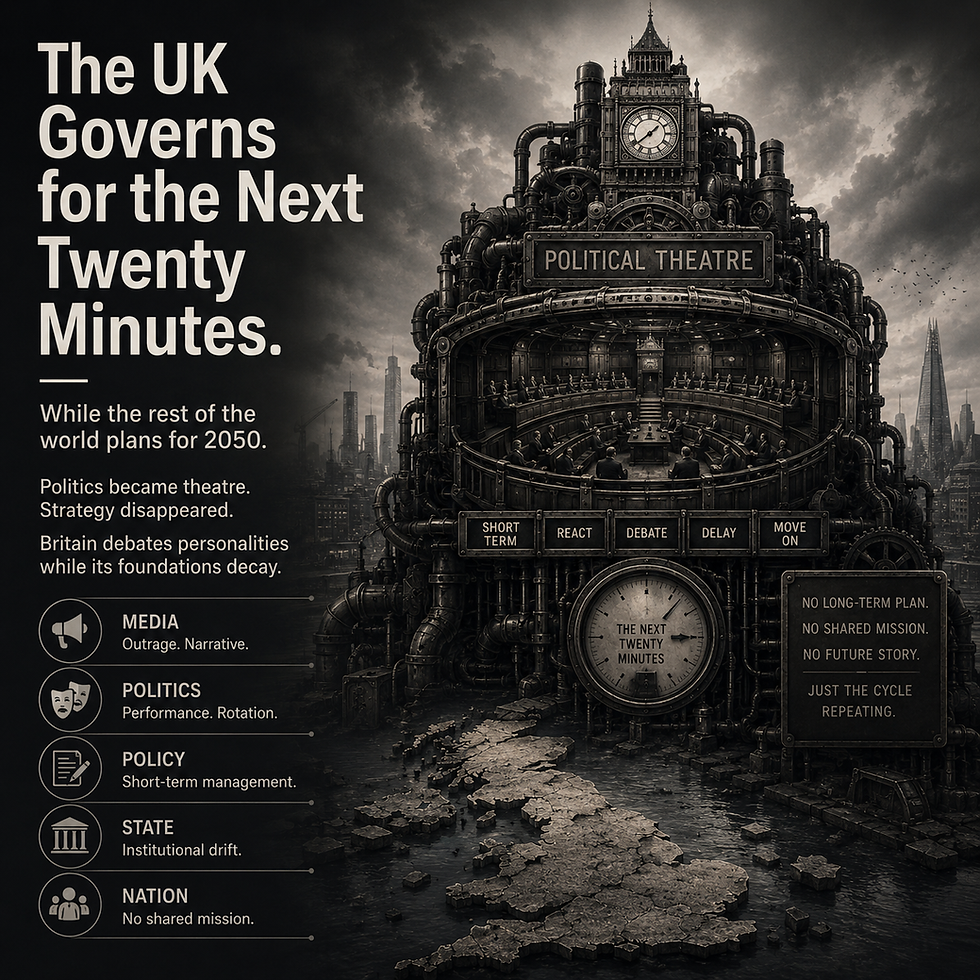
In a world being slowly boiled by capitalism, we’ve become like the frog in warming water — too dulled by the temperature rise to recognise that both arguments are missing the point. One side insists tax shouldn’t broaden: the other treats basic standards of living as somehow socialist. Both reveal a failure to understand either the word or the base arguments - and it is easy to understand why when the narrative in the political theatre frames it as such. This from a country that once shaped global systems, now producing a national budget to patch black holes so contextually small that there are people in the world that could clear them with their credit card.
So, we find ourselves trying to fund the solution to the social burden of our time using a mechanism designed for an era when that burden didn’t exist.
We tax labour to fund infrastructure and welfare in a world where labour no longer is the main value driver and welfare has drifted from being a safety net for the least fortunate to becoming a mechanism for avoiding the very work it was originally meant to protect.
This is not just inefficient. It’s absurd and to my mind sits at the root of the problem,
We’ve been here before of course; we’ve always been here before if we look hard enough. Sallustius wrote that Rome began to decline not when wealth arrived, but when it ceased to have a purpose beyond itself. When ambition became detached from the common good, when success was measured in acquisition rather than contribution, society hollowed from within.
He called it a decay of virtue long before it was a collapse of institutions. In other words: the system failed only once the leaders and the society within it did.
This of course feels uncomfortably familiar. We’ve built an economic logic where price stands in for value and individual advancement is treated as the natural end point of progress. Not so long-ago duty was the stabilising force. Today it is replaced by compensation, convenience, and algorithm.
This is something that sits at the people, rather than its leaders’ feet, we have asked the tax system to fund what the culture no longer sustains. I’m quite sure Sallustius would recognise the shape of this decline. It is not that the wrong people are in charge (which is not an argument I’d make!) I think where we have reached there are too that few feel responsible for the whole.
About 30% of UK tax revenue now comes from the top 1%. That statistic should end a lot of empty class debates, but it doesn’t—not because it is harder to argue with than it is to ignore but because to acknowledge it is to admin the system is structurally misalinged. Meanwhile, roughly eight million people are being paid not to work. Value has detached from contribution, so by extension contribution has detached from work. Gone are the days of it being a noble endeavour to be a teacher or a pastor or a local GP. Society no longer holds those things as valuable in their own right. This is not an argument about laziness or policy failure. It’s a structural consequence of designing today around the logic of yesterday.
Today’s budget doesn’t challenge that logic. It’s solving for the wrong challenge, correcting numbers rather than correcting premise.
Covid revealed this very clearly. It wasn’t an economic failure due to weak leadership (which it partly was of course)—it was an economic disaster because in 2020 the architecture of the country was misaligned with the world it was intended to govern.
People blamed the politicians for not protecting from every shock, without acknowledging that we had already dismantled the informal systems (family, community, proximity) that once absorbed those shocks before they reached the state. Countries had outsourced resilience, then were confused when government struggled to buy it back at retail price.
Last week I read a piece describing a trip to London hotel. A £400 room, no corkscrew for the wine - a very first world problem to be sure. But the writer described staff searching drawers like archaeologists hoping to stumble on something that resembles usefulness. An Uber booked for the wrong London Bridge. A five-mile journey taking 90 minutes with no one involved knowing where they were or where they were going. But this story does not speak of incompetence which it is lazily easy to do. Quite the opposite—each performed their role exactly as the system had trained them to. The problem was simpler than failure. Labour was present. Value was not.
This is what happens when a society is constructed around price rather than value. The UK was built on working in unison to build something greater. Today it imports labour to do work stripped of meaning, while paying people 8m people not to work. We seem to have lost what work is for. These things aren’t a human failure. They’re architectural. We hollowed work of purpose and then wonder why people stopped caring about doing it well.
Europe sits in the same inertia. Angela Merkel warned in 2012 that Europe had less than 10% of the world’s population, around 25% of its GDP, and almost 50% of its social protection spend. Today the ratios are even more skewed. Europe is financing demographic history rather than investing in economic future.
Contrast that with say Rwanda. Growth at around 9% with capital investment accounting for more than a quarter of GDP – much like he US of the 1950’s. Still with a deep degree of community support for each other, a collective incentive of obligation to a greater good. Rwanda and countries like it are building forward and their economies reflect that in the blended mix, where the UK and Europe are trying to rewrite Q1 2026 using base assumptions from 1926. Whilst the vibrant new economies of the Global South are doing a better job of navigating the new realities of the 21st century, they would do well to address the challenges currently facing Europe and the US as they grow - to avoid the same traps in a generation from now.
I’m not arguing left or right. I’m not arguing for higher or lower tax. I’m arguing that we must first accept the fact that the economic engine has shifted and the social load has shifted with it. And the tax logic has done neither.
Governments one after the other are designing policy for a country they remember from history, not the country people are living in now.
To continue taxing work as the proxy for value creation is to keep demanding that the worker hold together what society no longer does. It isn’t sustainable and to me nor is it fair.
Tax should not feel like what it has become - extraction. At its best, it is architecture that forms a spoke in a bigger wheel providing service and infrastructure where others provide labour and others drive capital creation. When working harmoniously these things work together. The Nordic countries have done quite well at finding this balance, not perfectly but with similar tax burdens to the UK they strike the balance much better.
The question isn’t how much tax we apply—it’s what era we think we’re applying it in.
Until a government has the courage to rethink what work now is — and where value truly sits — we will remain caught in the contradiction. Funding twenty-first-century social cost with nineteenth-century tax logic. Importing labour to perform roles stripped of purpose. Paying millions not to work instead of building a society in which work once again matters.
The point isn’t to tinker with thresholds or shave decimal points off deficits this is really just performative politics. It is to accept that the economy we live in is no longer the one those rules were written for. Either we redesign the architecture to match the age we live in, or the age will do it for us — abruptly, and without permission.
That moment is coming. Yesterday, as it turned out the bond market didn’t think the budget was particularly awful so there was a rally in gilts - a small win but the only real question for me is whether the old democracies of the west can step up to the real - and much broader - need for tax reform and meet it head on before it meets us.


Comments